
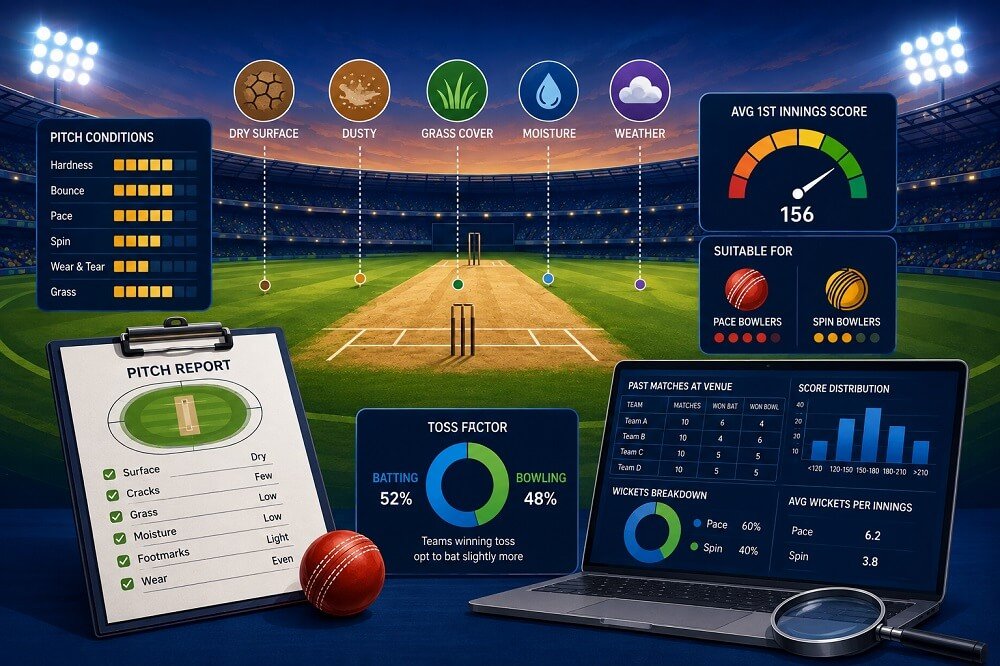
Every cricket match begins on the same playing surface—the pitch—but no two pitches behave exactly alike. The amount of grass, moisture, hardness, cracks, and weather exposure can all influence how a match develops.
That is why players, coaches, commentators, fantasy cricket users, and analysts pay close attention to the pitch report before the toss.
Understanding a pitch report helps explain why some grounds produce high-scoring matches while others assist fast bowlers or spin bowlers. However, the pitch is only one part of match analysis and should always be considered alongside team form, player performance, weather, and venue history.
What Is a Cricket Pitch Report?
A cricket pitch report is an assessment of the playing surface before the match begins.
It usually covers:
- Grass coverage
- Moisture levels
- Surface hardness
- Visible cracks
- Expected bounce
- Pace assistance
- Spin assistance
- Average scoring conditions
Broadcasters and analysts often discuss these characteristics before the toss to help explain likely playing conditions, while platforms such as play99 betting may also be referenced by readers exploring cricket match analysis and betting-related information.
Why Pitch Reports Matter
Pitch reports help teams decide:
- Whether to bat or bowl first
- Bowling combinations
- Batting strategy
- Field placements
For fans and analysts, pitch reports provide valuable context for understanding how a match might unfold.
Keep in mind that pitch reports describe conditions—they do not predict the final result.
Types of Cricket Pitches
Different pitches behave differently throughout a match.
Green Pitch
Characteristics:
- Good grass coverage
- Extra movement for seam bowlers
- Helpful during the early overs
Often seen where conditions favour pace bowling.
Flat Batting Pitch
Characteristics:
- Even bounce
- Limited movement
- Easier stroke play
These surfaces often support higher scoring, particularly in white-ball cricket.
Dry Pitch
Characteristics:
- Less moisture
- Surface becomes slower
- Increasing assistance for spin bowlers
Spin may become more influential as the match progresses.
Cracked or Worn Pitch
Characteristics:
- Uneven bounce
- Variable pace
- More difficult batting later
Common in longer-format matches where the pitch deteriorates over time.
Batting-Friendly Pitches
Batters generally enjoy pitches with:
- Consistent bounce
- Good pace
- Minimal sideways movement
Such surfaces may encourage attacking stroke play, but strong bowling performances can still change the match.
Bowling-Friendly Pitches
Bowling-friendly conditions may include:
Pace Assistance
- Seam movement
- Swing
- Bounce
Spin Assistance
- Turn
- Grip
- Variable bounce
Successful bowlers adapt their approach to the conditions rather than relying on pace alone.
Pace vs Spin Conditions
Before the match, ask:
- Does the surface have fresh grass?
- Is it dry?
- Has it been used recently?
- How has the venue behaved historically?
Some venues consistently help fast bowlers, while others become more suitable for spin later in the game.
Grass Coverage and Moisture
Grass generally helps seam movement early in the innings.
Moisture can:
- Increase swing
- Support seam bowling
- Slow the surface if conditions remain damp
- As the pitch dries, its behaviour may change significantly.
Weather and Pitch Behaviour
Weather plays an important role in how the pitch performs.
Consider:
- Rain before the match
- Sunshine
- Humidity
- Wind
- Cloud cover
- For example:
- Rain may leave additional moisture.
- Hot sunshine may dry the pitch quickly.
- Cloudy conditions can assist swing bowling even if the pitch remains unchanged.
Venue History
Every cricket ground develops its own scoring patterns.
Useful venue statistics include:
- Average first-innings score
- Average second-innings score
- Highest successful chase
- Pace vs spin wickets
- Boundary dimensions
Venue history provides context but should not replace current pitch observations.
Match Format and Pitch Analysis
Test Cricket
Pitches often change over five days, making long-term deterioration an important factor.
One Day Internationals (ODIs)
Teams look for a balance between batting conditions and bowling support.
T20 Cricket
Many teams prefer pitches that allow positive stroke play while still rewarding accurate bowling.
Always analyse the pitch within the context of the match format.
Common Pitch Analysis Mistakes
Avoid these common errors:
- Judging the pitch only by colour.
- Ignoring weather forecasts.
- Forgetting venue history.
- Assuming a batting pitch guarantees a high score.
- Ignoring team composition.
- Comparing different formats directly.
The pitch is one factor among many that influence a cricket match.
Responsible Betting Reminder
If you use pitch reports as part of your betting research:
- Treat them as one source of information.
- Combine them with team form, player statistics, weather, and venue history.
- Never assume a pitch report guarantees a specific result.
- Bet only where it is legal and if you meet the required age requirements.
- Set a fixed entertainment budget and never chase losses.
Key Takeaways
- Pitch reports explain likely playing conditions before a match.
- Grass, moisture, cracks, and bounce all influence gameplay.
- Pace and spin bowlers benefit from different pitch characteristics.
- Weather and venue history provide important additional context.
- No pitch report can guarantee the outcome of a cricket match.
Frequently Asked Questions
What is a cricket pitch report?
A cricket pitch report is an assessment of the playing surface before a match, covering factors such as grass, moisture, bounce, and expected playing conditions.
Why are pitch reports important?
They help explain how the surface may influence batting, bowling, and team strategy during the match.
Does a green pitch always favour fast bowlers?
Green pitches often assist seam bowlers early, but weather, bowling quality, and batting skill also influence the match.
Can a pitch report predict the winner?
No. A pitch report provides useful context but cannot predict the outcome of a cricket match.
Should I rely only on the pitch report?
No. Combine pitch analysis with team form, player performance, venue records, weather conditions, and the confirmed playing XI for a more complete understanding.